
"Anyone who wants to recognize the truth must first have doubted in the right way."
Aristotle
Questioning pain. Rethinking diagnostics.
Without an accurate diagnosis, no effective treatment is possible:
A large number of our patients have already been treated several times without the desired success. Even with surgical procedures, no lasting improvement could be achieved.
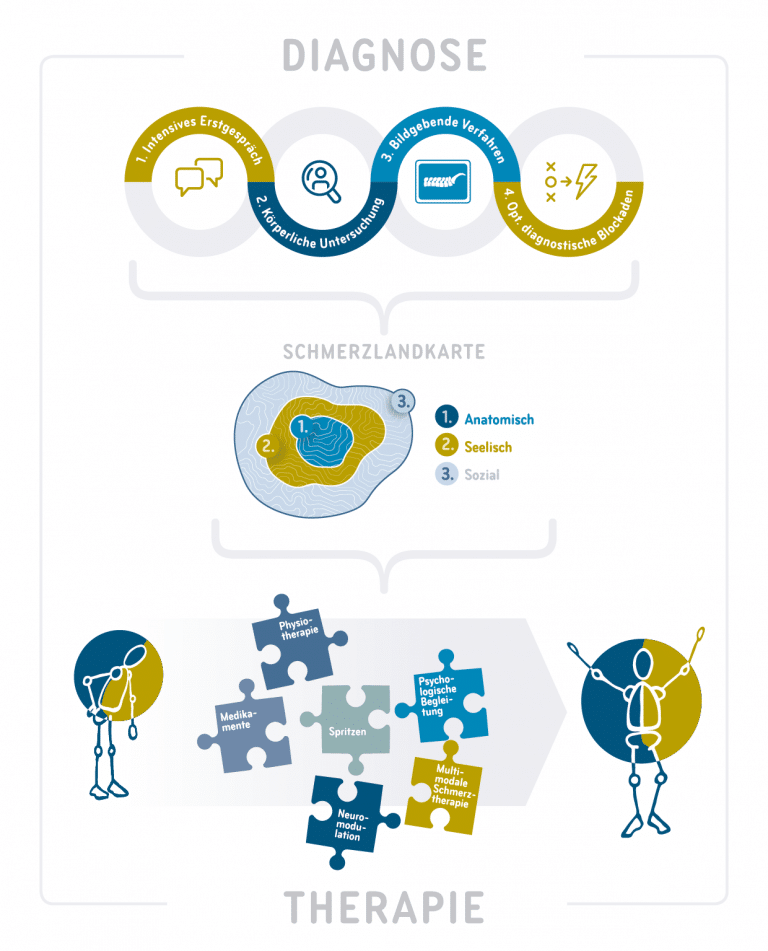
From the symptom About the diagnosis: what you can expect from us
1. Intensive: Initial consultation
At the end of the conversation, we want to know your symptoms and understand your problem. To do this, we work together with you to create a questionnaire so that nothing is overlooked. In addition, you have the opportunity to share details about yourself and your symptoms. Of course, details that have remained in the dark until now are also important. We view each of our patients as an individual, embedded in a complex network of biological, psychological, and social factors. We are aware of the connection between stress and pain. The Münchner Rückenschmerz Modell, developed in Munich, takes into account the multifaceted nature of your pain experience as the basis for our diagnostic procedures. We have state-of-the-art hardware and software available for the evaluation of imaging examinations brought along. The images are reviewed and discussed with you together. Important questions can be asked by you at the end of the initial consultation.
2. Physical examination: Reading between the lines
Even in times of high-resolution imaging, the classic physical examination has not lost its importance. After all, the goal for the examiner is to „understand“ the pain in accordance with the words used. Any physical examination of the spine involves orthopedic and neurological techniques. For example, painful trigger points or muscular tensions can be immediately detected with the appropriate fingertip sensation. Every one of our physical examinations also includes an initial assessment of the neighboring regions, such as the hip or shoulder region, to identify orthopedic comorbidities.
3. Imaging procedures as appropriate – referral for X-ray diagnostics, CTs or MRIs
Even in the most modern nuclear magnetic resonance imaging, pain cannot be directly visualized. Imaging techniques only show changes in body structures that may be associated with pain with certain probabilities – not necessarily. For example, in about half of all seventy-year-olds without back pain, herniated disc cases can be detected. Imaging techniques are therefore essential in detecting anatomical changes. On the other hand, their evaluation depends on the individual complaint picture and the experience of the physician. Radiologists and radiologists lack knowledge about the complaint picture and the examination findings of their patients. They therefore do not make diagnoses but describe deviations from the norm in their examination reports. In the pain clinic, if necessary, our radiology colleagues will take pictures and discuss them with you, assessing them in light of any possible connections to your symptoms.
4. If necessary, diagnostic blockages to identify individual pain-causing nerves
Diagnostic blockages have hardly been common in Germany. This is not entirely correct; they are essential in determining pain triggers. The reason: By local anesthesia of individual structures such as nerves, spinal joints, or trigger points, the source of the pain can be precisely identified, which makes accurate treatment possible.
Would you like to get a second opinion on a planned back surgery? You can contact us here.