Note regarding the language:
For the sake of better readability, we use the masculine form in this article. Of course, all genders are meant.
Anyone who suffers from persistent pain sooner or later turns to pain therapy. Affected people have usually already visited several practices of different specialties and tried a variety of treatments. Yet the symptoms persist. Eventually the term “pain therapy” comes up, but what exactly is done there?
Special pain therapy addresses both acute and chronic pain. Often it involves complaints such as back pain, headaches, migraines, or more complex pain conditions such as fibromyalgia or CRPS. Especially when pain persists for longer periods, it not only affects the body but also sleep, mood, performance, and therefore the entire daily routine.
Many patients only enter specialized treatment when conventional approaches have not provided sufficient relief or the cause remains unclear.
In this article you will learn how pain therapy works, what tests are performed, what treatment options are available, and how to recognize when a doctor is the right fit for your situation.
The most important information on pain therapy in a nutshell
- Pain therapy begins where pain persists for longer periods or remains despite treatment, with the aim of specifically identifying the cause of the pain and not merely alleviating symptoms.
- Accurate diagnosis is crucial to properly classify symptoms and avoid unnecessary measures or interventions.
- In treatment, various forms of therapy, such as medication, physiotherapy, or intervention methods, are combined appropriately.
- Especially in the case of chronic pain, multimodal pain therapy is considered an important approach for improving quality of life in the long term.
1. When does pain therapy become relevant for you?
Pain therapy becomes relevant most often when symptoms persist for longer than 6 months, do not disappear on their own, or occur repeatedly. Many affected individuals have already undergone various treatments at this point, without any noticeable change having been observed.
It is also typical that the pain begins to affect everyday life. Movement becomes more difficult, sleep becomes restless, or the ability to cope at work declines. By then, treating only individual symptoms often no longer suffices.
Even if you have already visited several practices or received different assessments, specialized pain therapy can help reframe the situation. The same applies if there is uncertainty before an operation and a second specialist assessment is desired.
Another important point: In specialized pain therapy, the goal is not just to relieve pain in the short term. Many patients come with complaints such as herniated discs, persistent back pain, knee pain, or pain that hasn’t disappeared even after surgery. The goal is to understand the actual cause of these symptoms and derive a structured treatment plan from it.
2. Your first appointment: This is how the examination works
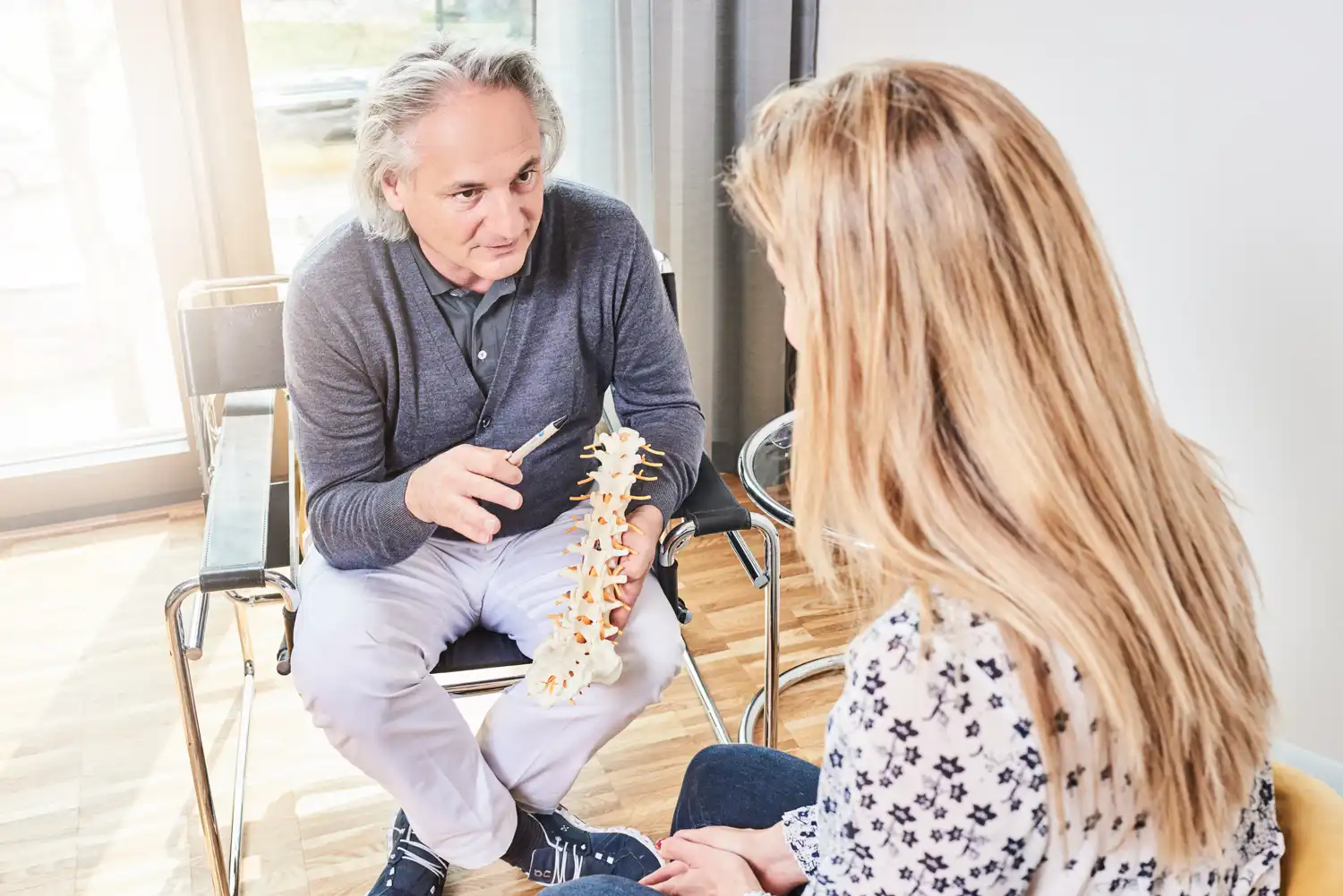
Before your first appointment in specialized pain therapy, it is important to complete the German Pain Questionnaire (more on this later). Then your first appointment in pain therapy begins with a detailed discussion. This involves your current complaints as well as your entire pain history. Which treatments have already been carried out? What worked and what didn’t?
During the conversation, specific questions are asked:
Where exactly do the pain occur? How long have they been present? How severe are they and how are they triggered or intensified? This information helps to better understand the pain process.
Subsequently, existing findings are reviewed. These include medical reports, MRI or CT scans, and other diagnostic findings. These are not considered in isolation; they are evaluated in the context of your current complaints. In doing so, we evaluate imaging such as MRI or CT scans ourselves and document them over time. This allows us to understand how changes have developed over time and which findings actually relate to your current complaints.
This is followed by a physical examination. This includes examining how your posture, mobility, and certain pain points are behaving. The goal is to determine which structures are actually involved in the pain.
At the end of the appointment, a preliminary medical assessment is conducted: is it more likely to be acute, recurring, or already chronic pain? Based on this, the decision is made regarding what next steps are appropriate.
3. Diagnosis: How your pain cause is defined
After the initial appointment, targeted diagnostics begins. The most important component is the history of pain symptoms. Your complaints are systematically recorded and documented.
It is precisely recorded:
- where the pain occurs
- How long they will last
- how strong they are
- which causes them to be triggered or amplified
The individual pain areas are not considered in isolation, but rather in relation to one another.
The crucial difference in classification
In pain therapy, not only a single area is examined; instead, the entire pain process is organized.
That means:
In addition to physical factors, influences such as stress, sleep, or everyday stress are also taken into account.
Especially in the case of chronic pain, these factors often overlap, and this is precisely what is made visible in the diagnosis. Therefore, individual treatments often do not have a lasting effect.
How to target pain sources
In certain cases, diagnostic infiltrations are used.
In this case:
- targeted anesthesia of individual structures was performed
- observe whether the pain changes
- so the actual source of pain is limited
An important step: Making connections visible
From all the collected information, a structured overview of the complaints is created. It shows:
- Which factors are involved in the pain
- Which findings are really relevant
- and how the individual causes are related
This is particularly crucial for long-standing pain, so that we do not just focus on individual symptoms.
The goal of diagnostics
The goal of this step is to assign your complaints as accurately as possible.
Specifically, this means:
- Better understanding of causes
- Recognizing connections
- avoid unnecessary measures
This creates a solid foundation for the further treatment.
4th treatment: These procedures are used
After the diagnosis, treatment is based on the connections found. What is crucial here is that there is no one single approach that fits everyone. Instead, different approaches are combined with each other.
Medications as a building block
Medications can be part of pain therapy. They help to influence the pain process or to alleviate acute discomfort.
At the same time, they are rarely the only method, especially for pain that has persisted for a long time.
Exercise and Physiotherapy
An essential part of the treatment is active work on the body.
These include:
- Physiotherapy
- Targeted physical therapy
- Exercises to improve stability and mobility
The goal is to make the body more resilient and to change unfavorable movement patterns.
Infiltrations at clearly identified pain sources
When the cause can be clearly identified, infiltration techniques are used in some cases.
That means:
- Targeted injections into affected structures
- often with local anesthetic or an anti-inflammatory (steroid)
- Direct influence on the occurrence of pain
Specialized procedures for certain conditions
Additional procedures may be necessary for more complex or chronic pain.
This includes, for example, neuromodulation. In this procedure, the transmission of pain signals in the nervous system is targetedly influenced by the use of electric current.
Psychological support as an important factor
Pain does not only affect the body. Especially in the case of long-standing complaints, stress, strain, and the way we deal with pain also play a role.
Accompanying support can help:
- to better understand the perception of pain
- Developing strategies for handling complaints
- to break the cycle of pain and stress
Why most often several components are combined
In the case of chronic pain, a single approach often isn’t enough. Instead, various procedures are combined specifically.
This approach is referred to as multimodal pain therapy. The German Pain Society also describes it as essential when symptoms persist over an extended period and several factors are involved.
What this means for you
The treatment is based on what actually alleviates the pain.
The goal:
- achieve noticeable relief
- to better cope with everyday life
- and in the long run develop more stability in dealing with pain
5. How to recognize a good pain therapist
A good doctor or therapist for specialized pain therapy is not only distinguished by a thorough professional training and careful approach, but also by at least 12 months of additional training and examination before the state medical board.
At the beginning, there is always an extensive discussion. Instead of judging too quickly, he takes the time to understand your complaints in detail and to categorize the previous treatment.
Existing findings are also specifically examined and placed in their overall context. Pain is viewed from several perspectives: physically, but also in relation to stress, daily life, and previous patterns.
It is also important that decisions are explained in a comprehensible way. You should always understand why a particular examination or treatment is being proposed.
Typical characteristics of good pain therapy are:
- Detailed diagnostics instead of a quick standard procedure
- an understandable explanation of the next steps
- Moderation in interventions when other methods are more appropriate
- Experience with complex or chronic pain conditions
- Collaboration between different disciplines as needed
Another crucial point: Pain is taken seriously as an independent disease entity.
How modern pain therapy can look in practice
At Schmerzwerkstatt München, the focus is entirely on the treatment of pain. Unlike in many practices where pain is only one aspect of the treatment, the entire concept here is consistently based on specialized pain therapy.
The focus is on outpatient multimodal pain therapy: with detailed diagnostics, the possibility of second opinions, and targeted procedures such as diagnostic blockades.
A team from various specialist areas works together on your treatment. This creates a personalized plan that takes into account the entire pain process.
Have your complaints specifically addressed in a specialized pain clinic. Here you can go directly for appointment scheduling!
Pain therapy at the Schmerzwerkstatt Munich: Its benefits
Targeted specialized pain therapy requires experience, time, and a structured approach. This is where the Schmerzwerkstatt München comes in: you receive a treatment tailored to your individual needs, from diagnosis to therapy.
Their advantages at a glance:
✔ More than 30 years of experience in pain therapy: Even complex or long-standing complaints are thoroughly evaluated, rather than being treated only superficially.
✔ Ambulant multimodal pain therapy: You remain in your familiar environment and still receive comprehensive, interdisciplinary treatment.
✔ Therapy planning based on diagnostics: Only when the cause of your pain is identified can a suitable treatment plan be created.
✔ Detailed discussions instead of hasty diagnoses: Their complaints are understood in detail, not just briefly evaluated
✔ Targeted diagnostic infiltrations: Accurate anesthesia of individual structures is used to determine where the pain is actually located.
✔ Combination of several therapy components: Movement, medical procedures, and other approaches are meaningfully coordinated with each other
✔ Interdisciplinary team from specialized departments: Various experts from neurosurgery, anaesthesia and general medicine work together on the patient, rather than implementing individual measures in isolation.
✔ Avoiding unnecessary interventions: It is thoroughly examined whether an operation or invasive measure is really necessary.
✔ Therapy that fits into your everyday life: The treatment plan is designed so that it can be realistically implemented
✔ Structure instead of endless doctor visits: You receive a coordinated overall concept, without having to coordinate yourself with different practices
✔ Early countermeasures for chronic pain: Targeted treatment prevents the pain process from becoming more entrenched.
If you would like to specifically clarify your concerns and receive a treatment strategy, you can get started here directly. for appointment scheduling!
6. Conclusion: What you achieve through pain therapy
Pain therapy is not just about taking pain medication. The goal is to understand the symptoms specifically, categorize the actual causes, and then develop an appropriate treatment based on that.
What is clear is that, especially in the case of chronic pain, several factors often interact. Therefore, a single therapeutic approach is often not enough. Only the combination of diagnostics, exercise, medical procedures, and supportive care can lead to noticeable improvement.
For you, this means not only short-term relief but the opportunity to better control your symptoms in the long term and to restore your quality of life.
The Schmerzwerkstatt München starts right here. Through detailed diagnostics, a multimodal therapeutic approach, and the collaboration of various disciplines, a treatment plan is created that is tailored exactly to your personal situation.
If you want to address your complaints specifically, the next step is a specialized examination. You can get there directly here. for appointment scheduling!
7. FAQ: Frequently asked questions about pain therapy
Pain therapy usually begins with a detailed diagnosis. During this process, symptoms are carefully recorded, existing findings are evaluated, and the cause of the pain is determined.
Based on this, a treatment plan is created that can combine various forms of therapy, such as medication, physiotherapy, or intervention methods. The goal is not only to alleviate symptoms but also to specifically treat the causes of pain.
In pain management, different methods are used depending on the cause and course of the condition. These include medication, physical therapy, and targeted injections under X-ray supervision.
In addition, relaxation techniques, movement therapy, or alternative methods such as acupuncture or Botox can also be used. The key is that the therapy forms are appropriately combined and tailored to the specific situation.
Chronic pain is usually present when symptoms persist for longer than three to six months or occur repeatedly. During this time, the pain process can change: the body „learns“ the pain, which can lead to what is known as pain memory.
This means that pain can persist even without an acute cause and a targeted, structured treatment becomes necessary.
When back pain occurs, an accurate diagnosis is always the first step. This involves examining whether the symptoms stem from the spine, muscles, or other structures.
Based on this, a personalized treatment plan is created. This may include physiotherapy, targeted exercises, medical interventions, or intervention procedures. The goal is to both alleviate pain and improve mobility and endurance in the long term.
Medications are often part of pain therapy, especially for the short-term relief of acute symptoms. However, in the case of chronic pain, they are usually not used in isolation.
Instead, they are part of a broader treatment plan that also considers other therapeutic approaches such as exercise, physiotherapeutic interventions, or psychological support.
Multimodal pain therapy is an approach in which different forms of therapy are combined. These include medical, physical, and psychological measures that work together to address the pain process.
This approach is particularly suitable for chronic pain, as multiple causes often play a role at the same time. By combining different approaches, treatment can be more targeted and long-term.
Yes, in many cases surgery is not necessary. Especially in the case of chronic or recurring symptoms, targeted conservative treatment approaches can be a good alternative. Through accurate diagnostics and coordinated treatment options, pain can often be significantly reduced without the need for surgical intervention.
Diagnosis is the foundation of any successful pain therapy. Only when the cause of the pain is clearly understood can a treatment plan be developed. This includes not only conversations but also physical examinations, the evaluation of findings, and in some cases targeted diagnostic procedures such as injections. The goal is to avoid unnecessary measures and to tailor the therapy specifically.
A good pain therapist takes the time to conduct a thorough history and considers complaints from several perspectives. It is important that the cause of the pain is the focus.
In addition, the therapist should explain in a clear manner which treatment options are available and why certain measures are recommended. Experience with chronic pain and collaboration with other professional disciplines are also important criteria.
The goal of specialized pain therapy is not always complete pain relief. In many cases, the goal is to significantly reduce the symptoms and to be able to better manage everyday life again.
These include improved mobility, greater resilience and better handling of pain. In the long term, the focus is on improving quality of life.